

My kitchen renovation started with a simple problem: I didn’t have enough savings to pay for everything upfront. I had already saved a portion of the money, so I approached my bank for financing. They offered me a personal loan at 14% interest. Although the loan could cover the remaining cost, the monthly EMI was high, and the total interest made the project considerably more expensive.
That’s when I realized that choosing the right way to finance a home improvement project can be just as important as choosing the renovation itself.
Then a friend told me about credit unions. She said, “You should check out a credit union home improvement loan. They usually have better rates.”
Honestly? I was skeptical. I had always banked with traditional banks. I didn’t know much about credit unions. But I decided to do some research.
What I discovered surprised me. Credit unions are not-for-profit organizations owned by their members . They return profits to members through lower fees, better interest rates, and improved services . That meant I could get a better deal.
I applied for a credit union home improvement loan. The process was straightforward. The interest rate was significantly lower than my bank’s offer. And the personalized service made me feel like more than just a number.
That experience changed how I think about financing home improvements. Today, I want to share what I learned with you.
My First Lesson – Not All Lenders Are the Same
Before we dive into the specifics, let me share the most important thing I learned.
When you need a home improvement loan, the lender you choose matters just as much as the loan itself.
Here’s what makes credit unions special:
- They answer to their members, not shareholders . Banks are for-profit institutions that need to generate returns for their investors. Credit unions are not-for-profit and pass savings directly to you.
- They offer more competitive rates . Since they don’t have shareholders demanding profits, they can offer lower interest rates and fees.
- They provide more personalized service . Credit unions are community-oriented. They treat you like a member, not a transaction.
If you’re wondering about a credit union home improvement loan, these differences can translate to significant savings over the life of your loan.
Read Also: Rustic Kitchen Decor: 7 Warm & Cozy Ideas for Your Home 2026
What Is a Credit Union Home Improvement Loan?
A home improvement loan is financing specifically intended to fund upgrades, repairs, and remodeling of a residential property . Home improvement loans can cover projects like kitchen remodels, bathroom renovations, patio upgrades, and outdoor kitchen installations .
A credit union home improvement loan is simply the same type of loan, but offered by a credit union instead of a traditional bank.
Types of home improvement loans at credit unions:
7 Reasons to Choose a Credit Union Home Improvement Loan
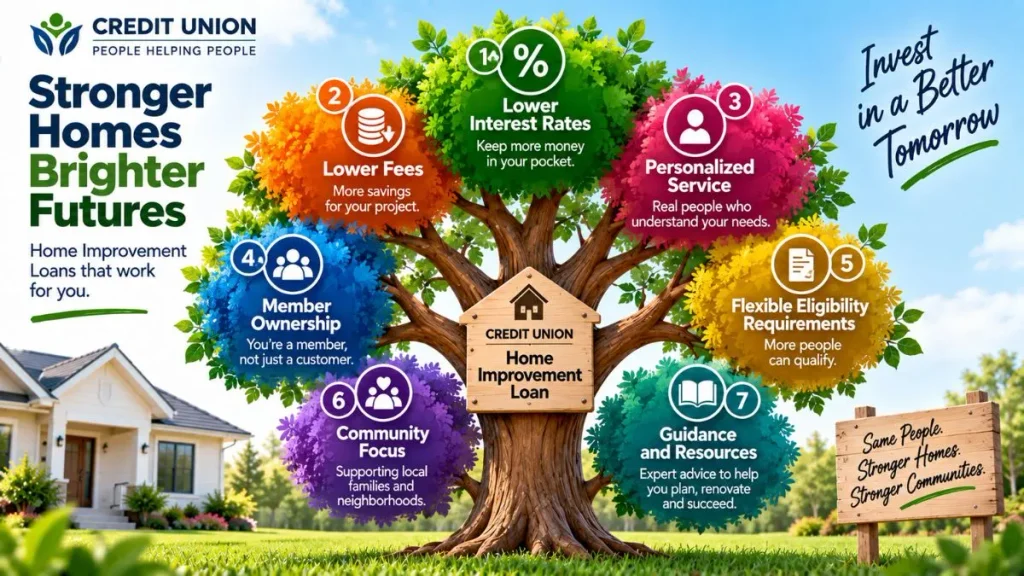
1. Lower Interest Rates
This is the #1 reason I chose a credit union home improvement loan. Because credit unions are not-for-profit, they can offer more favorable loan terms and lower interest rates .
My Story:
My bank offered me a personal loan at 14% interest. My credit union offered me a home equity loan at 8.5%. On a ₹5 lakh loan over 5 years, that difference saved me over ₹75,000 in total interest. That is real money.
What I Learned:
A lower interest rate can save you thousands over the life of the loan. Even a 1-2% difference adds up.
2. Lower Fees
Credit unions not only have lower rates but also lower fees . Banks often charge application fees, processing fees, and hidden administrative costs. Credit unions tend to keep fees minimal.
My Story:
My bank charged a ₹5,000 processing fee. My credit union charged ₹1,000. It was a small difference, but it all added up.
What I Learned:
Read the fine print. Fees can eat into your loan amount. Credit unions tend to be more transparent and member-friendly.
3. Personalized Service
Credit unions are community-oriented . When I walked into my credit union, they recognized me. They explained my options in plain language. I felt like I was talking to a neighbor, not a salesperson.
What It Means:
- You get one-on-one guidance
- They explain terms in simple language
- They work with you to find the right solution
4. Member Ownership
This is a unique feature of credit unions. When you become a member, you’re also an owner . You have a say in governance through an elected Board of Directors .
What It Means:
- The credit union works for you, not for shareholders
- Profits are returned to members through lower rates and better services
- You are part of a community, not just a customer
5. Flexible Eligibility Requirements
Credit unions often have more flexible eligibility criteria than banks . While banks might have strict credit score requirements, credit unions sometimes take a more holistic approach .
Common requirements:
- Must be 18 or older and a homeowner
- Must own the property and be on the deed
- Primary residence only
- Credit score may be lower than bank requirements
My Tip:
Even if you’ve been turned down by a bank, it’s worth applying with a credit union. They may offer more flexibility.
6. Community Focus
Credit unions are rooted in the communities they serve . When you take out a credit union home improvement loan, you’re supporting a local institution that invests back into your community.
What It Means:
- Funds stay local
- The credit union supports community initiatives
- You build a relationship with a trusted local institution
7. Guidance and Resources
Credit unions often focus on teaching members about their options rather than just selling products . You’ll find workshops, one-on-one counseling, and resources designed to help you make smart financial decisions .
My Story:
My credit union offered free financial counseling. They helped me understand my budget and choose the right loan product. It wasn’t just about selling me a loan—it was about helping me make the right decision for my situation.
How to Apply for a Credit Union Home Improvement Loan
The application process is similar to a bank loan. Here’s a step-by-step guide based on my experience.
Step 1: Assess the Scale of Renovation
Outline all key tasks—whether structural changes, system upgrades, or interior modifications—along with itemized cost estimates. This gives clarity on the total capital needed .
Step 2: Check Your Credit Score
A healthy credit score improves prospects for faster loan approval. A score above 700 generally improves your chances of approval . Try to aim for at least 700.
Step 3: Research Loan Options
Compare interest rates, maximum amounts, repayment structures, and fees . Credit unions may offer different products than banks.
Step 4: Collect Essential Documents
- Identity proof (Aadhaar, PAN Card, Passport)
- Address proof (utility bills, Aadhaar)
- Income proof (salary slips, IT returns, bank statements)
- Property documents (sale agreement, title deed)
- Renovation quotations or contractor estimates
Step 5: Apply Through the Credit Union
Many credit unions offer end-to-end digital services, from application to disbursement. Some may require physical branch visits for certain products.
Step 6: Justify Your Requirements
Be ready to explain the repairs or upgrades planned, supported by contractor quotes and budget sheets. Aspects that enhance the property’s utility or market value help in faster loan analysis .
Step 7: Consider a Co-applicant
Applying jointly with earning family members can combine incomes and qualify for a larger loan amount .
Credit Union vs. Bank – Which Is Better?
Common Mistakes to Avoid (I Made All of These)
Not checking credit union options: I went to my bank first. I should have compared credit union rates from the start. A credit union home improvement loan could have saved me money.
Choosing the wrong loan type: I considered a personal loan when a home equity loan would have been cheaper. Understand the options before applying.
Not shopping around: I accepted my bank’s first offer. Compare at least 3 lenders before deciding.
Underestimating costs: Get detailed estimates from contractors before applying. You don’t want to borrow too little.
Forgetting about fees: Read the fine print. Some lenders charge hidden fees.
Frequently Asked Questions (FAQs)
1. What is a credit union home improvement loan?
It’s a loan offered by a credit union to fund home repairs, renovations, and upgrades. Credit unions are not-for-profit member-owned institutions that often offer lower rates than banks.
2. Do I need to be a member to get a loan?
Yes, credit unions have membership requirements based on commonalities like community, workplace, or organization . You’ll need to become a member before applying.
3. Can I get a credit union home improvement loan with bad credit?
Credit unions often have more flexible requirements than banks. Some may consider applications with credit scores as low as 630-700 . But it’s not guaranteed.
4. What can I use a credit union home improvement loan for?
Kitchen remodels, bathroom renovations, patio upgrades, landscaping, roof repairs, energy-efficient upgrades, and more .
5. How do I find a credit union?
Search online for credit unions in your area. Many serve specific communities or professions. If you’re in India, check RBI regulations for cooperative bank loans—rural cooperative banks may offer housing loans with new expanded limits .
6. What documents are required?
- Identity proof
- Address proof
- Income proof
- Property documents
- Renovation estimates
Over to You – Explore Your Options
If you’re planning a home renovation, don’t automatically go to your bank first. Explore a credit union home improvement loan as an option. You might save money on interest, fees, and get a better overall experience.
I remember the relief I felt when I signed my credit union loan documents. The rate was lower, the service was personal, and I knew my payments were manageable.
Your home improvement project is a significant investment. The right financing makes all the difference.
So go ahead. Research credit unions in your area. Check their rates and terms. You’ll be glad you did.
Happy Renovating,
Sankar
(Founder, MyDecorideas.in)